
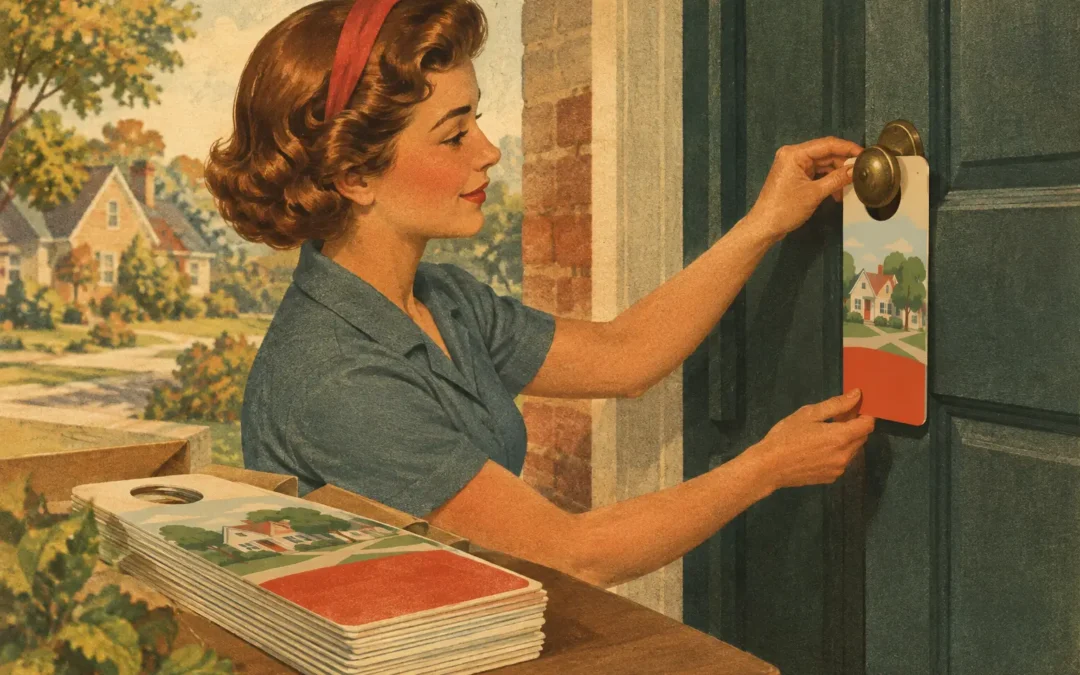
A door hanger gets one shot at earning attention: the few seconds a homeowner is standing at the front door with it in hand. That is why a good door hanger printing guide starts before the press runs. Your paper choice, layout, offer, quantity, and delivery plan all affect whether the piece gets read, saved, or tossed aside.
For a Mesa plumber, a Gilbert restaurant, or a Chandler real estate agent, door hangers work best when they feel relevant to the neighborhood receiving them. You do not need to be a print expert. You do need a piece that is easy to understand, built to hold up outdoors, and matched to a clear local goal.
Start With the Job the Door Hanger Needs to Do
Do not try to make one door hanger accomplish every marketing goal your business has. A new customer offer, a seasonal reminder, a grand opening, and a service-area introduction each need different messaging.
A home-service company may use a limited-time repair offer to drive calls now. A dentist may promote an easy first-visit special. A restaurant may focus on a menu item, delivery offer, or neighborhood coupon. If you are a real estate professional, you may want homeowners to request a pricing review or find out what nearby homes have sold for.
Pick one primary action before design begins. That action might be calling, scanning a QR code, visiting your location, booking online, or bringing in a coupon. When a hanger has five competing calls to action, the homeowner often does none of them.
Your offer also needs a reason to act soon. An expiration date, seasonal deadline, limited neighborhood special, or first-time customer incentive can help. Keep it honest. A vague promise of great service is not as trackable or as motivating as a clear offer with simple terms.
Choose a Size That Fits Your Message
The standard door hanger size is commonly around 4.25 by 11 inches, though sizes vary by printer and die cut. That format gives you enough room for a strong headline, one main visual, contact details, and an offer without overwhelming the reader.
Smaller hangers cost less and can work well for a simple coupon or appointment reminder. Larger pieces give restaurants, real estate teams, and businesses with several service categories more breathing room. Bigger is not always better, though. If the design has too much empty space or too much small text, a larger format will not fix it.
The door-hole shape matters too. Most campaigns use a standard round hole with a slit so the piece can slide over a doorknob. Ask your printer which die-cut template they use before finalizing artwork. Designing around the wrong template can put text, logos, or offers too close to the cut area.
Paper Stock Is a Delivery Decision, Not Just a Print Decision
Door hangers are handled by a crew, carried along a route, placed outdoors, and sometimes exposed to Arizona sun or a quick rainstorm. Thin paper may look fine when it leaves the box but can bend, curl, or feel inexpensive by the time it reaches a home.
For most local campaigns, a heavier cardstock is the practical choice. A 14-point or 16-point stock has a substantial feel and holds its shape well. If you want a premium feel for a higher-value offer, thicker stocks may make sense, but the added cost is not necessary for every campaign.
Gloss coating makes photos and bright colors pop, which can work well for food, fitness, retail, and colorful promotions. Matte finishes feel more understated and can be easier to write on if your team needs to add appointment details or a personal note. Uncoated stock is another option when writing space is central to the campaign, though it can show dirt and handling marks more easily.
In the Phoenix Metro area, do not rely on light ink colors or low-contrast type. Sunlight is harsh. A pale yellow headline on a white background may look clean on a screen but disappear at the door. Strong contrast wins.
Design for the Front Door, Not a Computer Screen
A homeowner should understand the basic message from arm’s length. That means your headline needs to be larger than you think, and it needs to say something useful right away.
Instead of leading with a logo, lead with the benefit. A pool company could say, Keep Your Pool Clear All Summer. A local restaurant could say, Dinner Is Around the Corner. A roofing company might use, Free Roof Inspection for Nearby Homeowners. Your business name should still be visible, but it does not have to do all the work.
Use both sides of the hanger with purpose. The front should earn attention quickly with a headline, a strong image or clean graphic, and your primary offer. The back can explain the service, list a few benefits, include reviews or credentials, and repeat the call to action.
Keep body copy short. Door hangers are not brochures. If the homeowner has to read a dense paragraph to understand the offer, they are likely to stop before getting to the phone number.
Your contact information should be impossible to miss. Include a phone number, website, address if foot traffic matters, and a QR code only if it leads to a mobile-friendly page. A QR code is helpful as a second response path, not a substitute for a clear phone number or offer.
Before printing, check the proof at actual size. Print it on a standard office printer if needed, cut it down, and hold it at a distance. Look for tiny text, crowded edges, hard-to-scan QR codes, and offer terms that are harder to read than the offer itself.
Set Up Artwork Correctly Before It Goes to Print
Good design can still produce a disappointing result if the production file is not set up correctly. Use high-resolution images, ideally 300 dpi at final print size. Blurry phone photos, screenshots, and logos copied from a website often look rough once printed.
Build in bleed around the outer edges. Bleed gives the printer extra image area to trim so you do not end up with thin white lines along the border. Keep critical content inside a safe margin, especially near the door-hole cut and the outer edge.
Use CMYK color settings for print whenever possible. Colors on a backlit screen can look brighter than ink on paper, particularly neon greens, vivid blues, and intense oranges. Ask for a proof if exact brand color is a major concern.
If file setup sounds like a headache, get design help before ordering a large run. Fixing a typo or low-resolution logo in a digital proof is easy. Discovering it after thousands of hangers are printed is not.
Order Quantity Based on Neighborhoods, Not Guesswork
The right quantity comes from the routes you want to cover. Start with the neighborhoods that match your service area, customer profile, and budget. A business that only serves the East Valley should not print a huge metro-wide run just because the per-piece price drops at a higher quantity.
Think in terms of homes, streets, and repeat coverage. A first campaign may target a few thousand homes around a restaurant, service territory, or recently completed job area. If results are promising, repeat the same area or expand into nearby neighborhoods. Repetition matters because local recognition builds over more than one drop.
Ordering extra pieces is smart when you need replacements for damaged items, want to hand out a few at events, or plan to leave stacks at your business. Just do not order so many that an expiring offer becomes outdated before you can use it.
Coordinate Printing With Delivery
A door hanger can be beautifully printed and still fail if the delivery plan is loose. Schedule production around the date you want crews in the neighborhood, especially when the offer is tied to an event, holiday, grand opening, or seasonal service window.
Confirm that the final quantity matches the selected route count. Make sure boxes are labeled and ready for the delivery team. And remember that door hangers belong on doors, not inside mailboxes. Mailboxes are regulated for postal use, so your campaign needs a distribution method that respects that boundary.
For business owners who do not want to coordinate separate designers, printers, maps, and street teams, The Flyer Guys AZ can manage the pieces together. Owner-led crew supervision adds accountability when materials are moving street by street through Mesa, Gilbert, Chandler, and nearby Phoenix-area neighborhoods.
Give Every Campaign a Way to Be Measured
Use a specific offer code, dedicated phone number, QR code, or landing-page message so you can tell door-hanger responses apart from other marketing. Train whoever answers your phone to ask new callers how they heard about you. That one question can reveal a lot.
Track more than immediate sales. Watch calls, quote requests, coupon redemptions, website visits, walk-ins, and repeat mentions of the offer. Some households will save a hanger and call weeks later, especially for services they do not need every day.
The best next step is simple: choose one neighborhood, create one clear offer, and print a hanger that looks as dependable as the business behind it. When the message is useful and the route is planned carefully, a front door can become a practical place to start a local customer relationship.